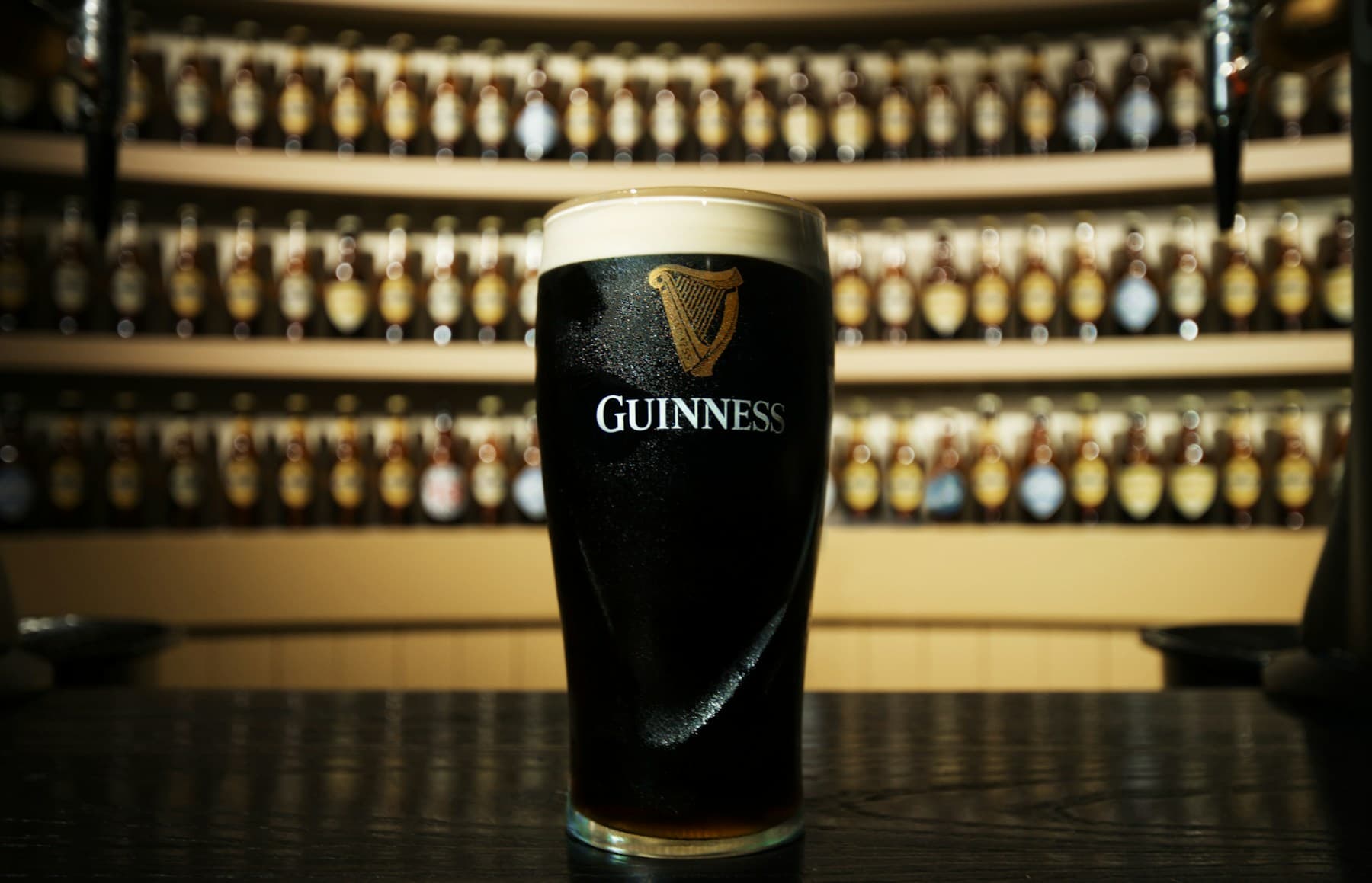
Diageo plans to increase the brewing capacity supporting Guinness by more than half over the next three years, taking the figure from 8.2 million hectolitres in its 2026 financial year to 12.7 million hectolitres in FY29.
The precise schedule appears in the company's official Guinness investment presentation, published for its Capital Markets Day on 6 August. The 4.5 million-hectolitre increase is 54.9%, which this article rounds to 55%.
The capacity timetable
- FY26: 8.2 million hectolitres.
- FY27: 10.2 million hectolitres, up 24%, as Littleconnell Phase 1 comes online in Diageo's capacity plan.
- FY28: capacity remains at 10.2 million hectolitres.
- FY29: 12.7 million hectolitres, up a further 25%, with Littleconnell Phase 2 online.
- FY30: capacity remains at 12.7 million hectolitres under the published schedule.
- FY31: a proposed further modular expansion at Littleconnell could lift capacity to 15.7 million hectolitres. Diageo says this depends on acquiring land, and assumes about 1 million hectolitres of the additional 3 million would be allocated to Guinness 0.0 capacity.
Diageo's financial year ends on 30 June, so FY29 is the year ending 30 June 2029. The company describes the FY26-to-FY29 increase as greater than 50%. The possible FY31 figure would be 91.5% above FY26 - close to, but not exactly, double.
Capacity is not the same as production
The distinction matters. Capacity describes the amount Diageo's brewing network is designed to be capable of producing; it is not a statement that Guinness output was 8.2 million hectolitres in FY26 or will automatically reach 12.7 million hectolitres in FY29.
Diageo did not publish Guinness's actual production in hectolitres in the materials reviewed for this report. Its FY26 results provide percentage movements for the brand instead: Guinness organic volume increased 7%, organic net sales increased 12% and reported net sales increased 11% in the year ended 30 June 2026.
The capacity chart is also labelled “Overall Guinness Beer Capacity”. Its bars comprise “Guinness & Other beer”, with Guinness 0.0 capacity shown separately. It should therefore be read as a capacity plan for the brewing network supporting Guinness, rather than as a forecast of pints sold or a brand-level output target.
The Guardian reported the announcement as a plan to double Guinness production and quoted chief executive Sir Dave Lewis saying the company would double Guinness capacity during the plan. Diageo's own dated capacity chart gives the more granular schedule used here: 8.2 million hectolitres in FY26, 12.7 million in FY29 and a conditional 15.7 million in FY31.
Where the $920m will go
Diageo plans $920 million of Guinness-related capital expenditure from FY26 to FY30. Of that, $670 million is earmarked for supply: $340 million for Littleconnell Phase 2, $240 million for packaging and $90 million for Guinness 0.0 processing.
A further $125 million is allocated to route-to-market investment, including equipment such as kegs and taps. The remaining $125 million covers land, brand homes and other capital spending.
These dollar figures come from the global Guinness investment deck and should not be combined directly with the separate euro-denominated investment programme announced for Ireland.
Littleconnell moves to the centre of the plan
Diageo opened the first Littleconnell brewery in Newbridge, Co. Kildare, in May after investing almost €300 million. That facility, built on a 40-acre site, produces ales and lagers including Rockshore, Harp, Smithwick's and Kilkenny, as well as licensed beers including Carlsberg.
The company has planning permission for an approximately €400 million second brewery at Littleconnell, with work due to begin in 2026. Brewery 2 is intended specifically for Guinness and Guinness 0.0 and is planned to more than double capacity at the Littleconnell site. That site-level statement is distinct from the 55% increase in Diageo's global Guinness capacity between FY26 and FY29.
Demand is running ahead of the wider group
The expansion follows another year of growth for Guinness while Diageo's group organic net sales declined 2.0%. In Great Britain, Diageo's organic net sales increased 2.9%, driven primarily by double-digit Guinness growth. Guinness 0.0 volume and net sales both grew by double digits in Great Britain, although the company did not publish exact percentages.
Diageo Beer Company USA organic net sales grew 4.4%, led by Guinness and Smirnoff ready-to-drink products, while Ireland organic net sales increased 3.2%, with Guinness growth supported by pricing and market-share gains.
Those results help explain the investment case, but the future capacity figures remain plans rather than achieved output. The FY31 expansion is explicitly presented as an option, and all of the forward figures depend on execution and demand.
Source and methodology: This report uses Diageo's 2026 Capital Markets Day materials, its preliminary unaudited FY26 results and its Littleconnell brewery announcement as the primary sources. The Guardian report supplied as the starting point is used as a secondary source. Percentages derived from capacity figures are rounded to one decimal place or the nearest whole percentage point. Capacity, actual output, sales volume and net sales are separate measures. Forward capacity and investment figures are company plans, not completed production. This article is financial reporting, not investment advice.